“U.S. oil production is on track to hit its highest level since 1993. What has that done to gas prices for consumers? Virtually nothing. Yet again, analysts are pointing out the obvious: even with massive increases in domestic oil drilling, the impact on gasoline prices is minimal. That’s because oil is a global market and U.S. supplies — even with historic increases — still don’t make a major dent.”
Maybe the RNC was just what Obama’s campaign needed…
There were a number of “are you kidding me?!?!?” moments during the republican convention. In particular for me was when Romney made a sanctimonious and sarcastic joke about the oceans rising. Just goes to show you exactly how some Republicans feel about the environment. (or at least, the people that Romney’s internal polling said would be most motivated by that statement)
Anyway, mocking a President for attempting to shepherd the country into a more environmentally-responsible future seems a little rich. Isn’t it a moral issue to treat the environment with respect?
Likewise, with health care. I’ve read a number of posts that basically make a moral case with regards to health care:
“when we as a country have become so small and stingy and mean that we cheer the idea of ripping medical care away from fellow citizens, offering nothing in its place but sanctimony and self-rightenousness… What are we? We’re not a country. We’re not a community.”
“Energy-related carbon dioxide emissions in the United States from January through March were the lowest of any recorded for the first quarter of the year since 1992, the federal Energy Information Administration reports. The agency attributed the decline to a combination of three factors: a mild winter, reduced demand for gasoline and, most significantly, a drop in coal-fired electricity generation because of historically low natural gas prices. Whether emissions will continue to drop or begin to rise again, however, remains to be seen, experts said Friday.”
Great news, for what’s its worth, however…
Of course, wind and solar energy greatly outperform any fossil fuel when it comes to efficiency. But last year those sectors supplied less than 5 percent of the nation’s electricity in 2011.
Dr. Apt is among those who believes that government intervention would be needed to cut emissions to acceptable levels. “If we see more and more variability in the climate, not just droughts but also more storms, there may very well emerge a consensus that we need to finally do something to stop this very dangerous unprecedented experiment that we’re doing on the planet,†he said.
We need government regulations at this point. The private sector will not steer us away from this. (Though it will be part of the solution, the innovations needed to solve this crisis will come from all sectors)
“In the late 1990s, Mann developed a graph that demonstrated a recent and dramatic uptick in global mean surface temperatures. The hockey-stick-shaped curve has become emblematic to both sides of the climate debate. To the vast majority of climate scientists, it represents evidence, corroborated by decades of peer-reviewed research, of global warming. To climate-change skeptics, the hockey stick is the most grievous of many illusions fabricated by thousands of conspiring scientists to support an iniquitous political agenda.”
If you “believe” in global warming, this article will just be mind-boggling to you. It is funny to even have to say “believe”. We can’t even talk about solutions in this country – we’re still debating whether we “believe” the overwhelming evidence of climate change.
Had a good discussion with Doug the other day about climate change and factors contributing to it. I was discussing my goal to cut back on driving and he pointed out (correctly) that personal transportation is not the majority of the problem. (Though it is about 30% of it)
Luckily, it seems, that presented will silly hot temperatures and brain-eating amoebas, wild fires, droughts, public opinion is shifting on the issue.
So why has it not been made an issue in the presidential campaign? (Rhetorical question) Obama should seize on this and let Romney and Ryan writhe around in denial, trying to speak to their base. As governor, Romney was pretty moderate, but as a republican presidential candidate you have to worry about things, like appeasing the oil and gas industry.
guilty for loving burgers. I wish the costs were upfront at the register. I’m telling you, a carbon tax is a good idea. Free markets rely on good information, and when you don’t have the full story when you make your decisions at the store – we make “sub-optimal” decisions.
One of the things about our globalized world is that the realities of economic activities are not close to the places of consumption. It’s clear to me that if we simply had more information about the costs of our actions, more people would be concerned about nature.
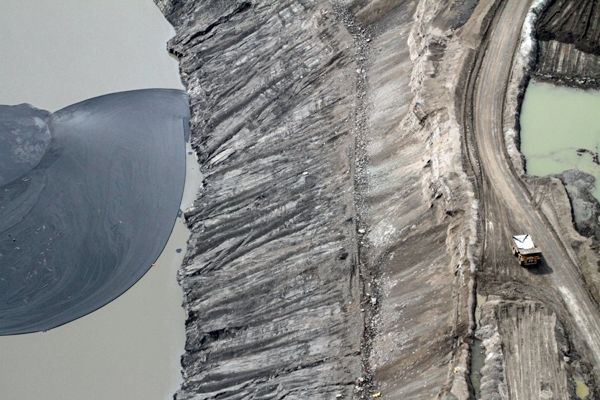
This series of photographs from the oil sands of Alberta, Canada is pretty amazing. The scale of the operations is absolutely staggering.
In one sense, Patagonia’s current success stems from classic business-school principles. The brand has maximized what B-school types refer to as WTP, or willingness to pay. Patagonia’s perceived quality and do-gooder aura convince customers that its goods are worth a higher price.
Also, I’ve been involved in many discussions about this concept over the past couple years, which I don’t completely understand how to integrate into my current environment. (emphasis mine)
It’s not just the marketplace Chouinard is affecting—it’s the workplace. His flex-time policies allow workers to come and go whenever they want—say, when waves are high at the nearby surf point—as long as deadlines are met. There’s a yoga room available any time of day (I walked in on the head menswear designer meditating there at around 11 a.m. on a Tuesday.) At the prodding of Chouinard’s wife, Malinda, Patagonia was one of the first companies in California to provide on-site, subsidized day care. Even the chief bean counter, COO and CFO Rose Marcario, seems spiritually fulfilled. In previous jobs at other companies, she says, “I might have looked for ways to defer taxes in the Cayman Islands. Here, we are proud to pay our fair share of taxes. It’s a different philosophy. My life is more integrated with my work because I’m trying to stay true to the same values in both.”

 Amazon.com
 Apple
Apple Hosted by Dreamhost
 Mozilla.org
 NetNewsWire
 NPR
NPR