Back for the second year in a row, I was able to join up with some work friends for a one-night camp-out in a not-too-close, and not-too-far-away campsite.
We went to Krueger Campground near Wabasha. It’s a fun area of the state that doesn’t look like what you might think of when you think of Minnesota. The campsite was tucked into a river bluff overlooking a large valley. Feeling very thankful for the extra day off this week, we had the whole place to ourselves.
The weekends during school get so packed with events and activities, I need to remember to reserve some nights for quick get-aways.
We continued the program set down last year of whipping up some true camping gourmet meals. Starting with some chips and cowboy caviar, we moved on to a fruit course (pineapple) before some impossible-sliders with secret burger sauce. Then a seafood course of salmon and potatoes, before a noodle and pork-belly dish.
I was stuffed to the brim, but the dessert was an elevated s’mores with stroopwaffles standing in for graham crackers. Delish.
After a hearty breakfast of chilaquiles, I didn’t want to head back to civilization. However, the beauty of the one-night get-away is that it’s a quick pack and drive back home. Before long, I set my direction north, hit play on a podcast and followed the river back home.
This new generation of climate activists is picking up the torch, now lit by LED. They recognize they have a life-and-death stake in the climate system they will be inhabiting for longer than anyone in my generation. Some of them are the children and grandchildren of those who have gone before. People like Sophie Kivlehan, James Hansen’s granddaughter, who served as a youth plaintiff in the landmark Juliana vs U.S. government. Although dismissed last year, the case argued that the government was violating the youngest generation’s constitutional rights to life, liberty, and property, as well as failing to protect critical public trust resources.
When an Outside editor reached out to ask me to write this story, I was on a trip to Marble Canyon, Arizona, to train raft guide companies on what is happening with the river. I drove my diesel Sprinter van from Tucson to the site, which tallied 383 miles at 20 miles per gallon of gasoline. When I ran the numbers later, the lifecycle water footprint of my fuel was around 110 gallons. One drive to the work I do on the Colorado River used more than 20 times the water of everything I did with AI in 11 weeks. That comparison stopped me cold—and I study this for a living.
despite having higher initial infrastructure costs to build because of overhead lines and electric substations, electric locomotives usually cost 20% less than diesel locomotives, according to the Environmental and Energy Study Institute. They offer superior performance and efficiency over diesel, featuring over 90% energy efficiency, higher acceleration and hauling power, lower operating costs (25%-35% less maintenance and costing up to 50% less to run) and zero tailpipe emissions. Electric locomotives don’t carry the weight of 3,000 to 5,500 gallons of diesel fuel. They surpass diesel locomotives while pulling urban and commuter trains, as well as pulling heavier freight trains because of their ability to be quieter with steady and high torque.
If US educational leaders were to consult their Swedish colleagues, the advice they’d likely get is not to remove digital technology whole cloth. “The goal is recalibration rather than reversal,” wrote Fälth. This was echoed in a statement sent to Undark by the Swedish Ministry of Education and Research: The “Swedish government believes that digitalization is fundamentally important and beneficial, but the use of digital tools in schools must be carried out carefully and thoughtfully.”
I’ve been reading and listening to Cal Newport for almost a decade now, and I’m a big fan of his work. His books, including Deep Work, Digital Minimalism and A World Without Email have been foundational in my thinking about how we use technology in our work and in our daily lives. He has a popular podcast as well, which I listen to regularly, much to my kids’ chagrin.
(I have no idea why they change the online title of this article to be worse… or at least more boring.)
It is quite a long essay, ironic, perhaps given that the thesis is that we’ve lost our ability to concentrate. It is well worth a read, because while he mostly focuses on education and the working world, there is a broader point about our society’s ability to focus and hold deep complex thoughts. Look no further than our current AI-Slop Social Media administration and I hope you begin to see the problem of placing people who are not deep-thinkers in charge of our government.
A diminished ability to use our brains also has concerning personal effects. Thinking is what lets us make sense of information in a complicated world. As president, Abraham Lincoln used to regularly retreat to his cottage, on the grounds of the Soldiers’ Home in the heights above Washington, to find the solitude needed to think intensively about the decisions facing him as commander in chief. A contemporaneous letter from a Treasury employee visiting Lincoln at the cottage during these years describes finding the president “reposed in a broad chair, one leg hanging over its arm. He seemed to be in deep thought.”
This was one of my favorite quotes from the article, mostly because the thought of how President Lincoln was sitting in this chair thinking makes me laugh.
I’m interested to know someone’s earnest argument against this article. I don’t believe that “It’s too hard” to make these changes is a valid argument. There’s a lot at stake. I’m interested in building a coalition here.
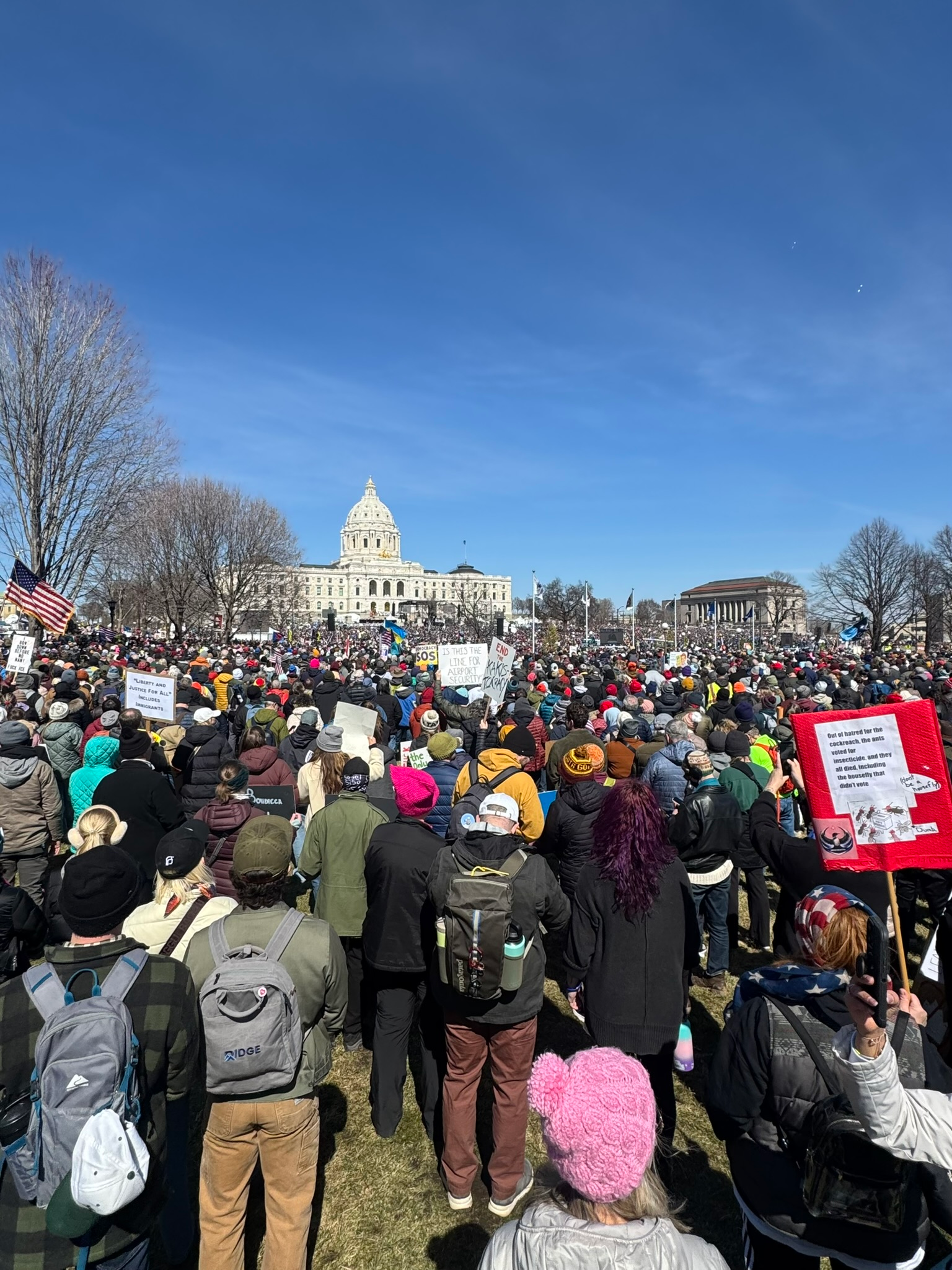
It was a beautiful day for a protest. We took public transit (the new B-Line BRT Bus) over to one of the rally points, and then marched from there to the capitol. It took over 45 minutes before we even started walking in earnest towards the capitol. When we arrived, the entire green space in front of the building was rapidly filling in, and by the time the speakers had started it was completely filled in. I greatly enjoyed reading all the clever (“For the Epsteinth Time…”), and not so clever signs that were brought to the rally.
I can’t find any estimates of the crowd size other than the organizers saying it was 200,000 people, and MPR having reported that at least 80,000 were expected. It was quite a bit larger than the previous rallies we had attended.
Being amongst 100,000 of your neighbors cheering and singing and chanting is exciting enough but the lineup of speakers and performers was extra special today, including some big names like Bruce Springsteen, Maggie Rogers, Joan Baez, Tom Morello, Bernie Sanders and Jane Fonda. I’m not sure I’ll ever see anything quite like it again.
There is a popular theory that for a mass resistance movement to affect the government it needs to mobilize 3.5% of the population. In the last presidential election in Minnesota there were about 3.2 million votes cast. If a conservative estimate of the crowd size today was 100,000 people, we’re getting pretty close to that 3.5% number.
3.5% of Minnesota’s 18+ population is 157,500. We’ve got a ways to go until the next election, but everyone needs to get out to vote!

 Amazon.com
 Apple
Apple Hosted by Dreamhost
 Mozilla.org
 NetNewsWire
 NPR
NPR