Friedman on Wikileaks

The Big American Leak – NYTimes.com

“. . . going through the WikiLeaks cables has made for some fascinating reading. What’s between the lines in those cables, though, is another matter. It is a rather sobering message. America is leaking power.”

Various Wikileaks Items

I’ve been following the wikileaks story pretty closely, but I’m less interested in what they’re releasing and more interested in what wikileaks means for the future of free speech here and elsewhere.

I don’t think it is an understatement to say that wikileaks will shake the American foundation of “free speech” and “freedom of the press”.

When you have potential a presidential candidate, Mike Huckabee, saying that Assange should be tried for treason and executed, you know we’ve got a problem. (Can’t be tried for treason, not an American citizen. But I guess you can’t give Huckabee too much credit for being an idiot, since a recent poll suggests 51% of Americans (and Glenn Beck) want leakers tried for treason, but I digress)

How many of those tea partiers are standing up for Assange? Not many.

You can’t have it both ways. You can’t fight corruption by fighting to hide corruption. You can’t fight government intrusion by not allowing the light to shine on government oversteps.

You can’t be for the free markets if you aren’t for free information.

And I guess I now agree with Ron Paul on something…

Ron Paul stands up for Julian Assange – Andy Barr – POLITICO.com

“‘In a free society we’re supposed to know the truth,’ Paul said. ‘In a society where truth becomes treason, then we’re in big trouble. And now, people who are revealing the truth are getting into trouble for it.’”

-Ron Paul

The tech community, which should be for open and free access to information, has failed us, says Dave Winer.

Scripting News: A perfect Wikileaks storm for Berkman:

“We now understand that we can’t look to the tech industry or even the Library of Congress. The tech industry more or less failed the neutrality test, and the LOC has failed the unwritten code of librarians everywhere.”

-Dave Winer

And if you want to hear from the man himself, Julian Assange, I suggest the following interview. It is pretty comprehensive.

An Interview with Julian Assange – Forbes.com

In a rare, two-hour interview conducted in London on November 11, Assange said that he’s still sitting on a trove of secret documents, about half of which relate to the private sector. And WikiLeaks’ next target will be a major American bank. “It will give a true and representative insight into how banks behave at the executive level in a way that will stimulate investigations and reforms, I presume,” he said, adding: “For this, there’s only one similar example. It’s like the Enron emails.”

also, on being a “computer hacker”

“There’s a deliberate attempt to redefine what we’re doing not as publishing, which is protected in many countries, or the journalist activities, which is protected in other ways, as something which doesn’t have a protection, like computer hacking, and to therefore split us off from the rest of the press and from these legal protections. It’s done quite deliberately by some of our opponents. It’s also done because of fear, from publishers likeThe New York Times that they’ll be regulated and investigated if they include our activities in publishing and journalism.”

-Julian Assange


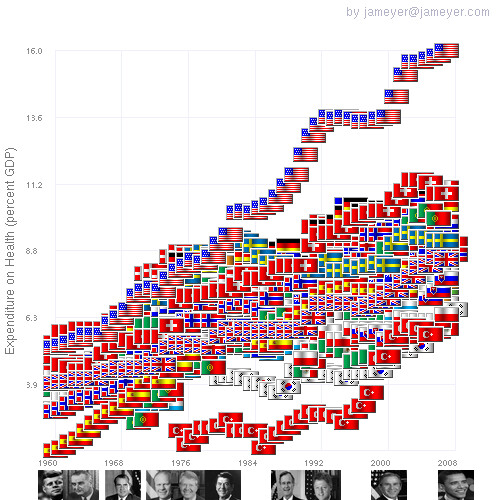
Health Expenditure as a percentage of GDP

Hmm, strange… in 1980 and in 2000 there was a dramatic increase…

Time to re-read 1984

How our “security” obsession costs us – National security – Salon.com:

“Of course, the U.S. national security state has quite a different formula for engendering safety in America: fight the Afghan war until hell freezes over; keep the odd base or two in Iraq; dig into the Persian Gulf region; send U.S. Special Operations troops into any country where a terrorist might possibly lurk; and make sure the drones aren’t far behind. In other words, reinforce our war state by ensuring that we’re eternally in a state of war, and then scare the hell out of Americans by repeatedly insisting that we’re in imminent danger, that shoe, underwear, and someday butt bombers will destroy our country, our lives, and our civilization. Insist that a single percent of risk is 1 percent too much when it comes to terror and American lives, and then demand that those who feel otherwise be dealt with punitively, if they won’t shut up.”

Time to re-read 1984?

Google Traffic at 1:00am

Wicked ice storm last night here in the Twin Cities. Sonja and I were driving home after a dinner party. This screen shot from the gentleman behind east-lake.net pretty much sums it up.


Google Traffic at 1:00am:


(Via east-lake.net.)

Like Democracy Itself, It Needs Defending

If I could have all of my friends and family really understand one “technology” thing I am passionate about, it would probably be net neutrality. Net Neutrality is fundamental to the way the web has developed thus far, and I’m afraid that most people just don’t know or don’t care anymore to know when it is being threatened.

Internet access in America is actually quite poor compared to other developed countries. As mentioned in the following article, Finland has made 1mbps internet access a basic right of citizenship. We pay more money for slower access than most other developed countries. (Sounds like our health care system, eh?)

Tim Berners-Lee, the creator of the web, has written an article in Scientific American that I hope you’ll take a look at.

Like Democracy Itself, It Needs Defending: “Long Live the Web — An impassioned plea to actively support openness on the Web from Tim Berners-Lee.

‘The principle of universality allows the Web to work no matter what hardware, software, network connection or language you use and to handle information of all types and qualities. This principle guides Web technology design.

Technical standards that are open and royalty-free allow people to create applications without anyone’s permission or having to pay. Patents, and Web services that do not use the common URIs for addresses, limit innovation.

Threats to the Internet, such as companies or governments that interfere with or snoop on Internet traffic, compromise basic human network rights.

Web applications, linked data and other future Web technologies will flourish only if we protect the medium’s basic principles.’

(Via MetaFilter.)


Comparing Tax Plans

The Washington Post has a great infographic comparing the Republican and Democratic tax plans.

Remember my last post about unequal distribution of wealth?